

Modern metal furniture factories rely heavily on intelligent equipment—especially laser pipe cutting machines, pipe bending machines, and laser welding robots—to ensure precision, strength, mass-production consistency, and aesthetic quality.This article provides an in-depth explanation of how these machines function within the production workflow of a metal folding dining table.
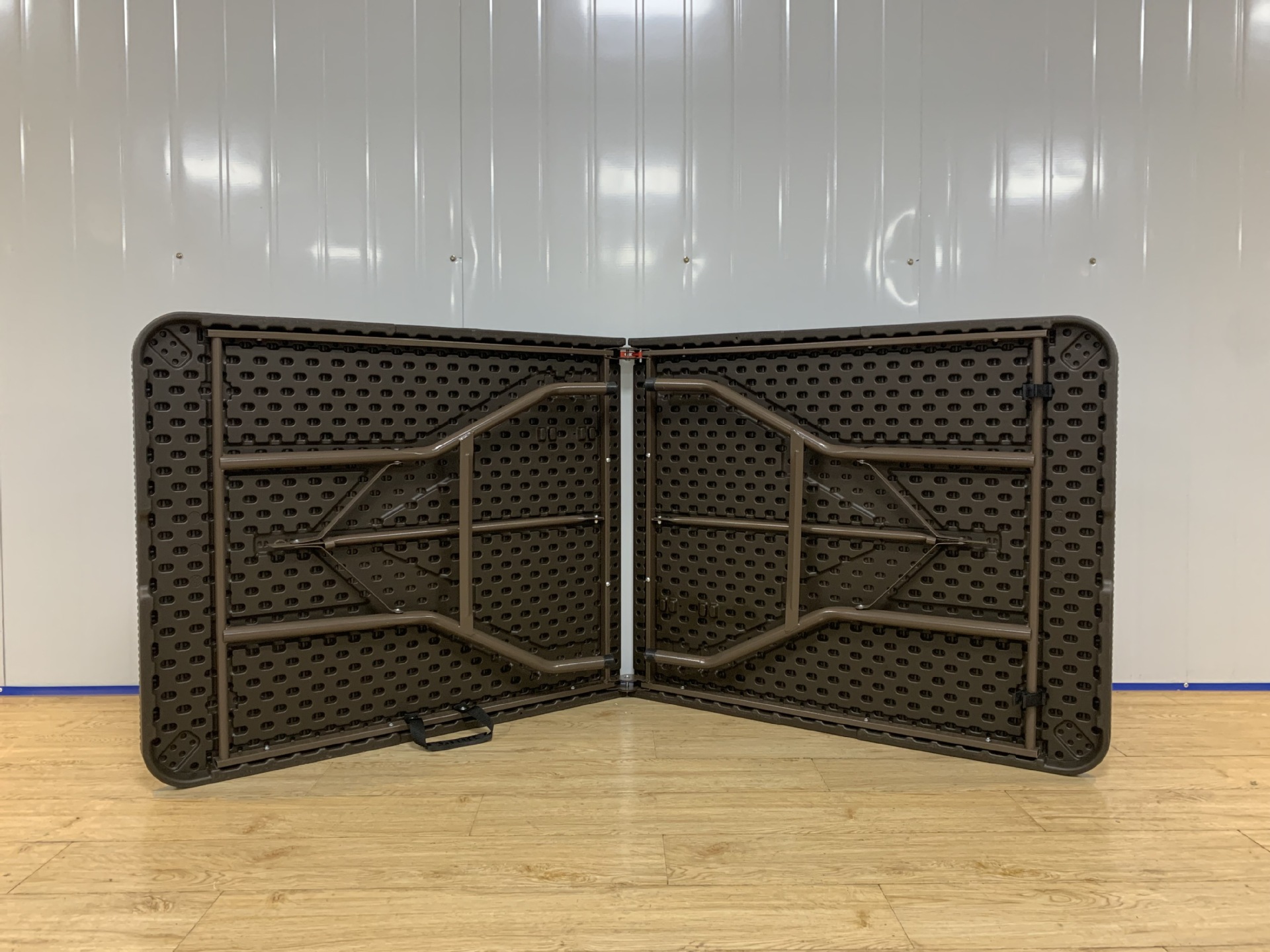
1. Precision pipe Processing: The Role of Laser pipe Cutting Machines
The frame of a metal folding table is typically made from round, square, or rectangular steel or aluminum tubing. Compared with traditional saws, punches, or manual cutting, laser pipe cutting machines offer several essential advantages.
1.1 High-Precision Cutting for Structural Stability
In table manufacturing, even a 1–2 mm deviation can cause wobbling, uneven leg heights, or misalignment during assembly. Laser pipe cutting machines operate with extremely precise automated positioning systems, ensuring each pipe is cut to exact dimensions.
1.2 Complex Cutting Capabilities for Functional Joints
Many folding table designs require special joints—such as oval slots for rotating pins, rectangular openings for cross-sections, and angled bevels for hinge connections.
These intricate cuts allow designers to integrate folding mechanisms directly into the tubing without needing separate components, reducing weight, material cost, and assembly complexity.So the laser pipe cutting machine would be better.
1.3 Automation and Consistency for Mass Production
For large-scale table manufacturing, consistency is critical. Laser pipe cutting machines can run automated batch programs that process hundreds or thousands of identical pipes with no human error.
With automatic loading and unloading systems, the laser pipe cutting machine becomes part of a continuous production line, improving efficiency and enabling factories to scale up production while maintaining quality.

2. Forming the Structural Framework: The Function of pipe Bending Machines
After the pipes have been cut, the next essential step is shaping them. pipe bending machines transform straight pipes into curved or angled components used in table legs, brackets, and supporting frames.
2.1 Creating Ergonomic and Aesthetic Curves
Modern folding tables often feature smooth, curved legs or subtle angles that enhance stability and appearance. Pipe bending machines use CNC (Computer Numerical Control) programming to shape pipes with perfect repeatability.
Unlike manual pipe bending machine—which can cause wrinkles, flattening, or distortion—CNC pipe bending machine ensures:
Uniform curvature
Preserved pipe diameter
No visible dents or surface damage
This is especially important for consumer furniture, where visible metal surfaces must remain smooth and sleek.
2.2 Ensuring Functional Precision for Folding Mechanisms
Folding tables depend on exact geometries. A leg that is even slightly mis-bent can cause:
Difficulty in folding or unfolding
Uneven table height
Stress on hinges or welds
Reduced long-term durability
CNC pipe bending machines liminate these issues by calculating the correct bending angle, radius, and sequence. For example:
Cross-brace pipes must be bent to meet hinge points precisely.
Supporting legs require identical angles on each side to ensure balance.
U-shaped stabilizers must be symmetrical to avoid instability.
2.3 Compatibility with Different Materials and Wall Thicknesses
Metal folding tables can be made from various materials—steel, stainless steel, or aluminum. Each material reacts differently under stress.
Advanced pipe bending machines automatically adjust parameters such as:Mandrel pressure,Bending speed,Feeding accuracy.

3. Structural Assembly and Aesthetic Finishing: The Importance of Laser Welding Robots
Once the metal parts are cut and bent, they must be assembled into a strong and reliable frame. This stage is where laser welding robots play a crucial role.
3.1 Precision Welding for Strong and Lightweight Frames
A folding table’s strength depends heavily on the quality of its welds. Weak welds can lead to wobbling, loosening, or long-term failure.
Laser welding robots offer several key advantages:
Minimal heat distortion, protecting thin-wall pipes
Deep and narrow weld seams for strength
High precision, ensuring straight and clean joints
Reduced spatter for smoother surfaces
These features make laser welding robots ideal for visible furniture surfaces where aesthetics matter.
3.2 Automated Welding for Complex Structures
Laser welding robots can be programmed to navigate these dynamic geometries, welding in tight or angled positions that are difficult for manual welders. They can rotate parts automatically, adjust beam direction, and maintain uniform quality across each weld.
3.3 Improving Production Efficiency and Reducing Labor Costs
Automation significantly speeds up production. Laser welding robots can work continuously with minimal supervision, producing thousands of identical welds with consistent quality.
This reduces:Labor time,Operator fatigue,Human error,Rework and repair costs
In a competitive manufacturing industry, the use of laser welding robots is essential for maintaining both quality and profitability.
Conclusion
The production of a metal folding dining table is far more complex than it appears. Beneath its simple and functional design lies a manufacturing process that relies heavily on advanced automated technologies.
Laser pipe-cutting machines ensure precise and flexible design possibilities.
pipe bending machines create the ergonomic, structural forms required for foldable mechanisms.
Laser welding robots deliver the strength, durability, and appearance that consumers expect.